
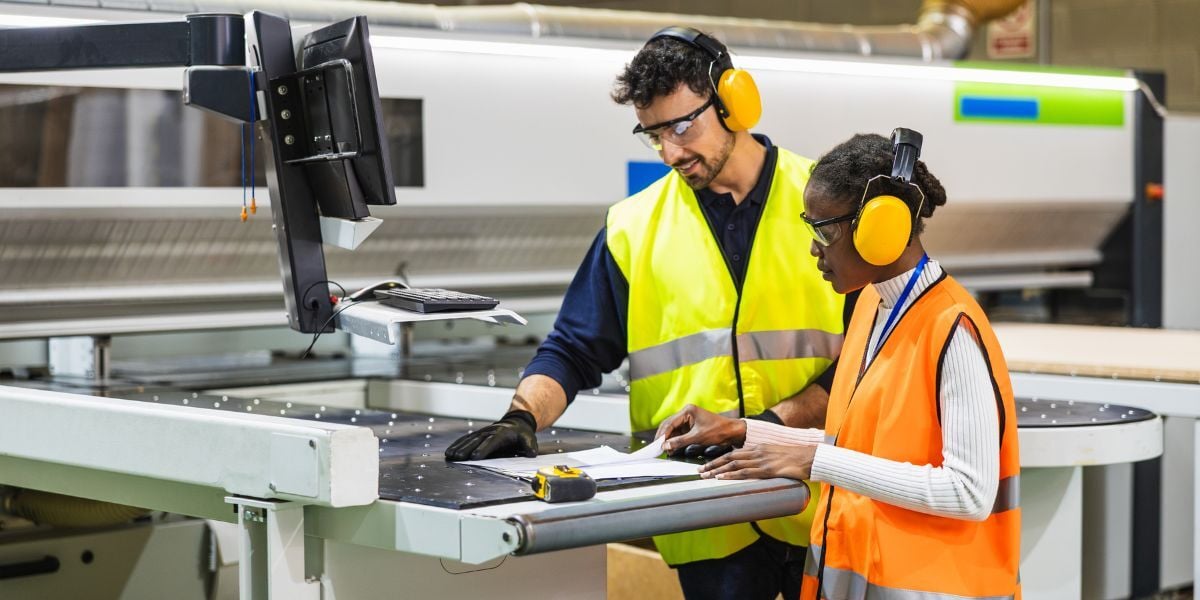
Quebec Manufacturing Is Entering a New Era
Quebec's manufacturing industry is undergoing one of the most significant transformations in its history. After several years marked by labor shortages, supply chain disruptions, rising costs, and international trade tensions, a new industrial revolution is underway.
This transformation is being driven by robotics, industrial automation, artificial intelligence (AI), data, and smart factories.
For Quebec manufacturers, this is no longer simply about investing in new machinery. It is about rethinking how products are made to improve productivity, increase flexibility, and remain competitive in the years ahead.
Canada Is Accelerating Investments in Automation
Canada is among the countries actively investing in the manufacturing technologies of the future.
In 2017, the federal government launched the Pan-Canadian Artificial Intelligence Strategy, with an initial investment of $125 million to accelerate the development of AI across the country.
Since then, several government initiatives have supported industrial automation, robotics, digital technologies, and manufacturing innovation. In 2026, business modernization remains at the heart of several support programs available to Canadian manufacturers.
This direction reflects a global trend: to remain competitive, manufacturing economies must invest in their ability to produce more efficiently.
Why Manufacturers Are Accelerating Their Transformation
Several factors are driving this shift.
Labor Shortages
Recruitment remains one of the manufacturing sector's biggest challenges. Companies continue to face difficulties recruiting machinists, welders, operators, electromechanics technicians, and other skilled workers.
In this environment, automation and robotics are becoming important tools for maintaining and increasing production capacity despite limited labor availability.
Rising Production Costs
Higher costs for raw materials, energy, and labor continue to put pressure on profit margins. Manufacturers are therefore looking for ways to produce more with the same resources while reducing waste, downtime, and inefficiencies.
Increasing Global Competition
Quebec manufacturers are competing against highly automated companies around the world. Productivity, flexibility, and adaptability are becoming major competitive advantages.
Robotics Doesn't Simply Replace Workers. It Transforms Their Roles
One of the concerns frequently associated with robotics is its potential impact on employment. In practice, automation is primarily transforming the nature of many manufacturing jobs.
Workers can spend less time performing repetitive, physically demanding, or higher-risk manual tasks and focus instead on higher-value activities.
This evolution is increasing demand for roles such as:
- Robotic cell operators;
- Robot programmers;
- Automation technicians;
- Engineers;
- Machine vision specialists;
- Industrial data and artificial intelligence specialists.
The automated factory of tomorrow will still need people, but the skills required will continue to evolve alongside technology.
Smart Factories Are Gradually Becoming a Reality
Over the coming years, manufacturers will increasingly move toward connected production environments. The objective is to enable information to flow between machines, robots, management software, and production systems.
This approach, commonly associated with Industry 4.0 and smart manufacturing, can help manufacturers:
- Monitor production in real time;
- Detect anomalies faster;
- Optimize production parameters;
- Improve traceability;
- Automate certain decisions;
- Improve quality control;
- Reduce downtime.
Data is becoming an essential resource for improving manufacturing performance.
Three Technologies That Will Transform Quebec Factories
1. Intelligent Robotics
Industrial and collaborative robots are becoming increasingly intelligent, flexible, and connected.
Innovation is no longer limited to the capabilities of the robot itself. Robots are increasingly becoming part of a broader technological ecosystem within the factory.
Connected to machine vision systems, ERP software, sensors, production control systems, and artificial intelligence, robots can receive and use more information to adapt their operations. This connectivity opens the door to significantly more flexible applications.
For example, a robotic cell can use machine vision to recognize different parts, automatically adjust a trajectory, perform quality inspections, or receive production information directly from another system.
Whether it is an industrial robot or a collaborative robot (cobot), the trend is toward systems that can communicate with their environment and make certain decisions based on available data.
This evolution will allow manufacturers to automate more variable production environments and tasks that were previously difficult to automate.
In the coming years, the value of a robotic cell will therefore depend less on the robot alone and increasingly on the intelligence, data, and technologies surrounding it.
2. Artificial Intelligence
Artificial intelligence will play an increasingly important role in manufacturing operations.
Its applications will extend far beyond conversational assistants and administrative tasks.
In a factory environment, AI can contribute to:
- Automated inspection and quality control;
- Predictive maintenance;
- Production scheduling optimization;
- Intelligent production planning;
- Manufacturing data analysis;
- Anomaly detection;
- Robot programming assistance;
- Process optimization.
Combined with robotics and machine vision, AI can also help automated systems better interpret their environment and adapt to more variable production.
For many manufacturers, artificial intelligence will represent one of the next major steps in their digital transformation.
3. Industrial Internet of Things (IIoT)
The Industrial Internet of Things (IIoT) allows equipment, machines, robots, and sensors to communicate with each other and continuously transmit data. This information can then be used to better understand what is actually happening on the production floor.
This connectivity creates several opportunities:
- Reduced unplanned downtime;
- Improved quality;
- Predictive maintenance;
- Lower maintenance costs;
- Energy consumption monitoring;
- Equipment performance tracking;
- Overall Equipment Effectiveness (OEE) monitoring.
Over time, the combination of connected equipment, data, and artificial intelligence will allow manufacturers to gradually shift from reactive production management toward a more predictive approach.
The Future of Manufacturing Will Also Be More Flexible
One of the most significant changes will likely be the ability of automated systems to manage a greater variety of products.
Historically, automation was particularly well suited to very high-volume, low-mix production. New generations of robots, vision systems, software, and programming tools are gradually changing this reality. A single robotic cell can now be designed to perform multiple operations or handle different products.
This flexibility is particularly important for Quebec SMEs, where production often involves lower volumes and a high variety of parts.
Manufacturing Will Become More Sustainable
The transition toward smart factories also supports sustainability objectives.
New technologies can help manufacturers:
- Reduce material waste;
- Lower energy consumption;
- Optimize material and product movement;
- Reduce scrap;
- Extend equipment life;
- Improve product traceability.
Economic performance and environmental performance are therefore becoming increasingly complementary.
Which Industries Will Be Most Transformed by Automation?
Across Quebec and Canada, several industries are already accelerating their transformation.
These include:
- Food processing;
- Wood products;
- Metal fabrication;
- Welding;
- Machining;
- Mining;
- Agriculture;
- Transportation;
- Logistics;
- Industrial equipment manufacturing.
Across many of these industries, investments in robotics and automation are increasing in response to labor shortages, productivity challenges, quality requirements, and global competition.
Automation Is Becoming More Accessible to SMEs
For many years, automation was perceived as an investment primarily reserved for large multinational corporations and very high-volume production environments.
That reality is changing.
Robots are more flexible today, while the technologies surrounding them make it possible to develop applications suited to a much broader range of production environments. Standardized robotic cells, cobots, offline programming, machine vision, and simplified programming interfaces are also helping make automation accessible to more manufacturers.
In addition, various government programs can support investments in productivity, automation, and digital transformation.
Where Should Manufacturers Start With Automation?
Transforming a factory does not necessarily mean automating everything. The first step is to identify the operations where automation can generate the greatest value.
Manufacturers can begin by evaluating:
- Repetitive tasks;
- Positions that are difficult to fill;
- Operations with ergonomic or safety risks;
- Production bottlenecks;
- Recurring quality issues;
- Underutilized equipment;
- Operations involving significant material handling;
- Processes currently limiting production capacity.
The objective should never be automation for automation's sake.
A successful automation project should solve a specific operational problem and generate measurable improvements in productivity, capacity, quality, safety, or flexibility.
Revtech Helps Manufacturers Build the Factory of the Future
At Revtech Systems, we believe automation is about much more than installing a robot.
It starts with understanding a manufacturer's operations, identifying real opportunities for improvement, and determining which technologies can deliver a tangible return on investment.
Whether through industrial robotics, collaborative robotics, industrial automation, machine vision, artificial intelligence, or systems integration, our team helps manufacturers transition toward smarter, more connected, and higher-performing production environments.
The Factory of the Future Is Already Being Built
The future of manufacturing in Quebec will be shaped by intelligent robotics, automation, artificial intelligence, and digital technologies. Manufacturers that invest in productivity today and progressively develop their technological capabilities will be better positioned to address the challenges ahead: labor shortages, global competition, rising costs, increasingly variable production, and higher quality requirements.
The next manufacturing revolution will therefore not be driven by robots alone.
It will be driven by the ability to connect machines, data, systems, and people to create smarter and more flexible factories.
The factory of the future is no longer a concept. It is already being built.
Sources:
https://globalnews.ca/news/7661927/jobs-canada-robitics-artificial-intelligence/
https://leyton.com/ca/insights/articles/evolution-de-lindustrie-robotique/