
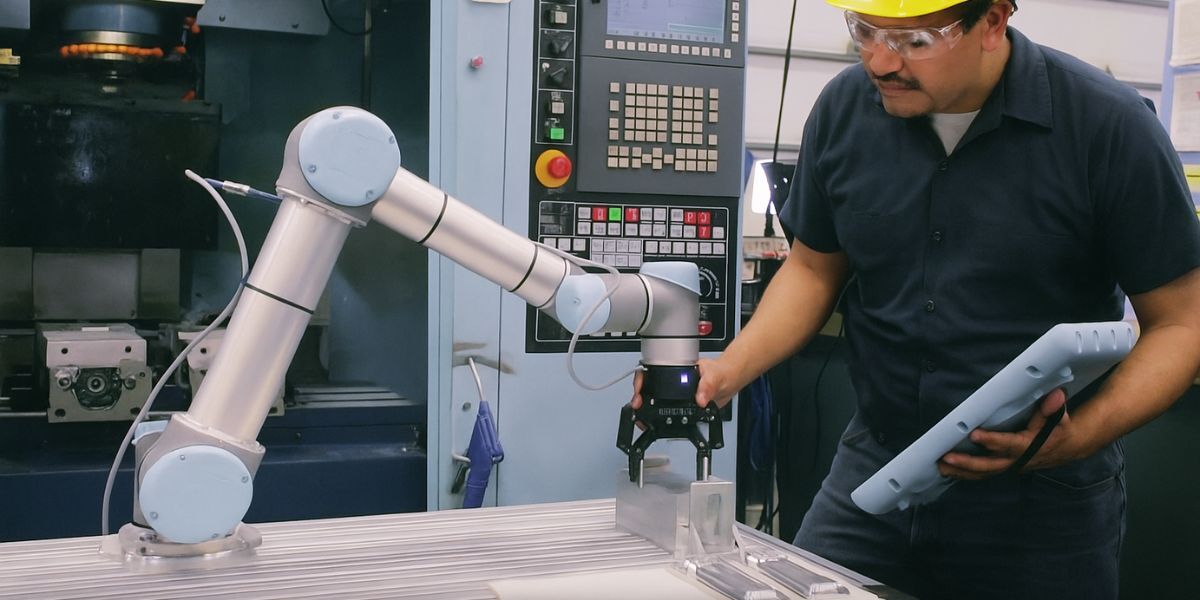
Manufacturers Face a Dual Challenge: Shrinking Workforce and Increasing Complexity of High-Value Tasks
In today’s context, targeted automation of low-value positions has become an essential strategy to maximize operational efficiency while safeguarding competitiveness.
This need is further amplified by new restrictions on hiring Temporary Foreign Workers (TFWs) in certain regions of Quebec, such as Chaudière-Appalaches, which will be heavily impacted starting in fall 2025. Several manufacturers, particularly in Estrie, are already anticipating reduced shifts and short-term productivity losses. (Source)
What Is a Low-Value-Added Position?
A low-value-added position can be defined by the following characteristics:
- High task repetitiveness
- Little to no human decision-making required
- Marginal contribution to product or service differentiation
- Exposure to ergonomic risks (MSDs, injuries)
Typical examples include:
- Feeding conveyors
- Loading CNC machines
- Manual palletizing
- Simple visual sorting
- Gluing or closing packaging
While these tasks are necessary, they do not leverage the operator’s judgment or expertise.
Why Prioritize Automating These Positions and How to Identify the Right Ones?
- Optimize existing human resources: By automating simple tasks, you free up operators to be reassigned to higher-value roles (quality control, maintenance, machine setup).
- Reduce turnover: Low-value positions are often linked to boredom, fatigue, or physical strain, leading to high employee turnover.
- Improve quality and consistency: Robots deliver uniform execution without fatigue-related errors, enhancing overall quality.
- Increase production capacity: Robots can run across multiple shifts with minimal downtime, boosting capacity without additional hiring.
A Four-Criteria Framework to Identify Target Positions
- Repetitiveness: Same movement repeated more than 500 times per day
- Standardization: Parts or operations are relatively consistent
- Ergonomics: Tasks involve awkward postures, forced movements, or exhausting pace
- Cycle time: Operation has a clear and predictable cadence
A simple production line audit makes it possible to score each position against these four criteria and pinpoint areas with the fastest potential gains.
Smart Reallocation of Operators
Automation does not mean cutting human jobs. On the contrary, it enables you to:
- Promote operators into more technical roles (programming, maintenance)
- Strengthen quality control and logistics positions
- Deploy multi-skilled operators across several critical stations
Targeted automation of low-value-added tasks represents a high-return strategy for Quebec manufacturers. By freeing up human resources for the most critical roles, companies can improve efficiency, quality, and operational stability while adapting to today’s labor market realities. The cultural impact is also positive when automation is presented as a tool for empowerment, not replacement.
FAQ :
- What are the easiest tasks to automate?
Simple, repetitive tasks with little variability (loading, sorting, palletizing) are the most cost-effective to automate. - Will my employees resist automation?
The key is communication: position automation as an opportunity for role evolution rather than a threat. It allows the company to maintain full production instead of shutting down shifts when labor is lacking. - Can a job be partially automated (without eliminating it)?
Yes. Automation can target a single motion or one specific phase of the work cycle. - Can an automation project be deployed over time?
Absolutely. Many companies start with a prototype or a single cell, then scale gradually based on return on investment.