
Finding and retaining factory workers is becoming increasingly difficult. For manufacturing SMEs, every vacant position slows production, raises costs, and reduces competitiveness. In this context, automation represents a powerful strategic lever.
At Revtech Systems, we recently helped a client in the food industry modernize their tea bagging process.
Current Process: A Time-Consuming Manual Operation
Until Now, Production Worked as Follows
- The machines produced individual tea bags (50–60 bags per minute).
- The bags dropped one by one into a collection bin.
- Operators manually filled larger bags containing 12, 15, or 50 tea bags each.
The Limits of This Method
- Labor shortage: Difficult to find and train workers for repetitive manual tasks.
- Low productivity: Production rate depends directly on operator speed.
- Repetitive, strenuous work: Increased risk of errors, fatigue, and musculoskeletal injuries.
Revtech’s Solution: A Robotic Cell with a Collaborative Robot
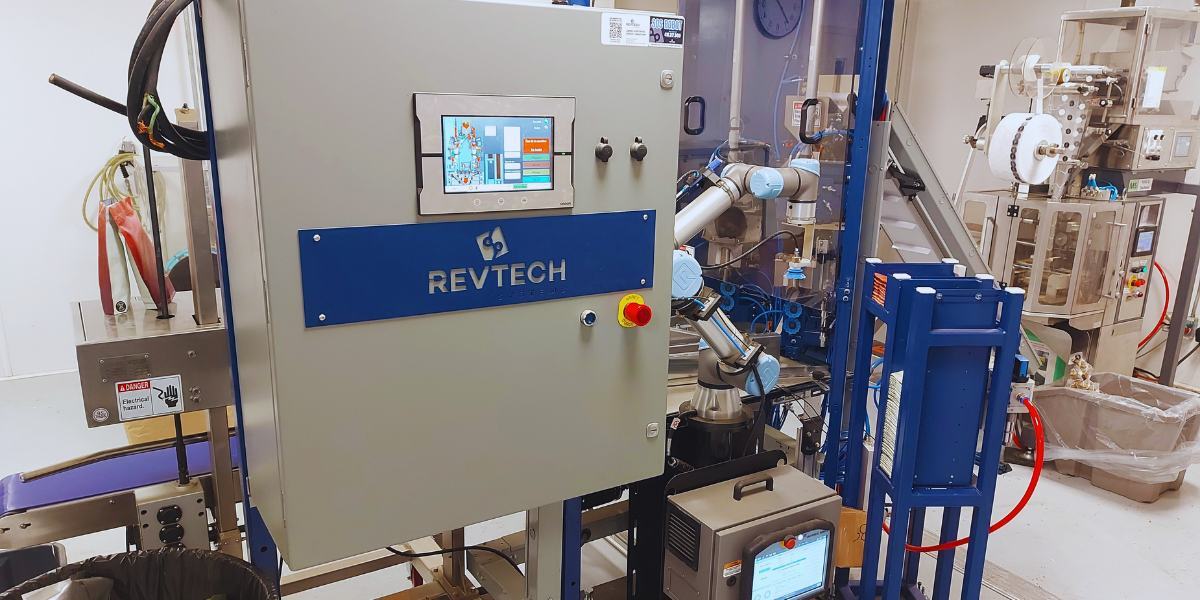
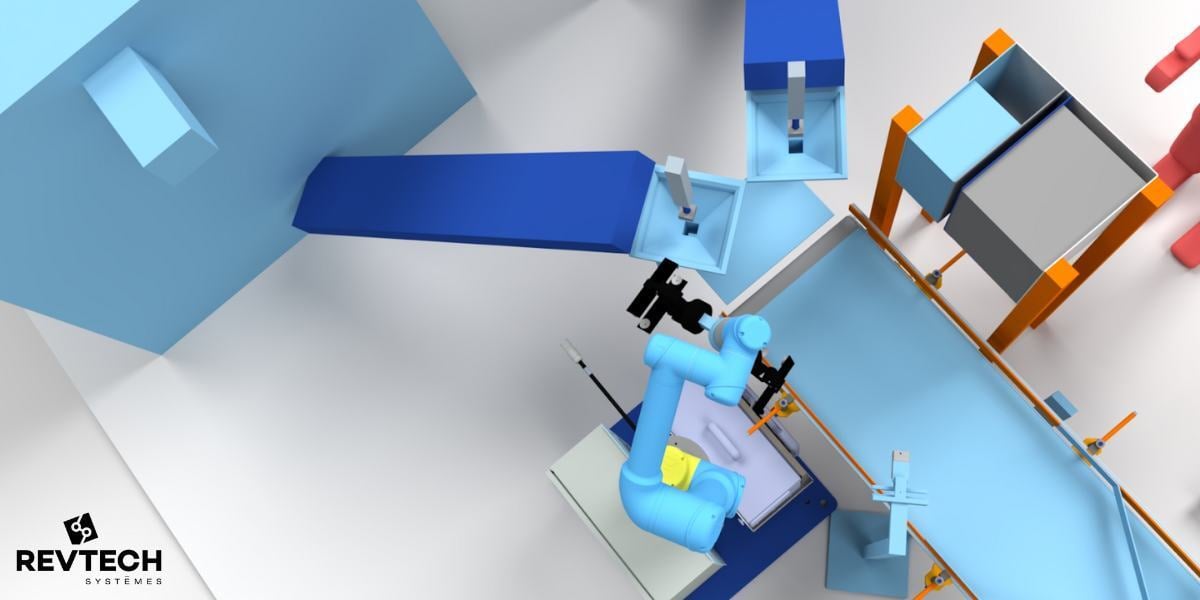
To address these challenges, Revtech designed an automated bagging cell integrating a UR5e collaborative robot and several specialized systems.
Main Components of the Cell
- Inclined conveyor: Transfers the tea bags to a drop zone equipped with a funnel.
- Automated counting: Sensors ensure the exact number of bags (12, 15, or 50) before transfer.
- Bag handling and opening: The robot grips each bag, opens it partially with suction cups, and inflates it using an air blower.
- Precise filling: Tea bags are dropped into the bag through a funnel with a pusher system to prevent overflow and ensure optimal compaction.
- Exit conveyor: Once filled, the bag is automatically placed onto the conveyor feeding the client’s existing sealing machine.
Why Choose a Collaborative Robot (UR5e)?
The UR5e cobot offers several strategic advantages:
- Space-saving design: No safety fencing required thanks to built-in safety systems.
- Enhanced safety: The robot stops automatically upon detecting abnormal force.
- Quick deployment: Intuitive interface minimizes operator training time.
- Flexibility: Can adapt to different bag formats and production volumes.
Expected Results for the Client
- Reduced dependency on manual labor in a competitive job market.
- Increased productivity with a steady flow of 50–60 bags per minute.
- Improved working conditions by eliminating repetitive and physically demanding tasks.
- Faster return on investment through a more stable and efficient production line.
This tea bagging automation project illustrates how robotics can transform a manual operation into an efficient, safe, and sustainable production process.
FAQs
- Is an automated bagging project only suitable for large companies?
Not at all. Thanks to collaborative robots, robotic cells are now accessible to SMEs—even those with modest production volumes. - How long does it take to deploy such a solution?
Depending on the project’s complexity, deployment usually takes a few months, including pre-engineering, integration, testing, and operator training. - What adjustments are required in the factory?
A dedicated space must be available to host the robotic cell. Revtech recommends providing the area dimensions to optimize the design. - Is it safe for employees?
Yes. Collaborative robots are designed to work safely alongside humans. A full risk assessment is performed before commissioning to ensure compliance and safety.